
爱与罚
Does China’s weak domestic demand really lead to excess capacity?: People's Daily_我的网站

一 |
Labor Day is a U.S. national holiday held the first Monday every September. Unlike most U.S. holidays, it is a strange celebration without rituals, except for shopping and barbecuing. For most people it simply marks the last weekend of summer and the start of the school year.
The holiday’s founders in the late 1800s envisioned something very different from what the day has become. The founders were looking for two things: a means of unifying union workers and a reduction in work time.
The first Labor Day occurred in 1882 in New York City under the direction of that city’s Central Labor Union.
In the 1800s, unions covered only a small fraction of workers and were balkanized and relatively weak. The goal of organizations like the Central Labor Union and more modern-day counterparts like the AFL-CIO was to bring many small unions together to achieve a critical mass and power. The organizers of the first Labor Day were interested in creating an event that brought different types of workers together to meet each other and recognize their common interests.
However, the organizers had a large problem: No government or company recognized the first Monday in September as a day off work. The issue was solved temporarily by declaring a one-day strike in the city. All striking workers were expected to march in a parade and then eat and drink at a giant picnic afterwards.
Why was Labor Day invented?
Labor Day came about because workers felt they were spending too many hours and days on the job.
In the 1830s, manufacturing workers were putting in 70-hour weeks on average. Sixty years later, in 1890, hours of work had dropped, although the average manufacturing worker still toiled in a factory 60 hours a week.
These long working hours caused many union organizers to focus on winning a shorter eight-hour work day. They also focused on getting workers more days off, such as the Labor Day holiday, and reducing the workweek to just six days.
These early organizers clearly won since the most recent data show that the average person working in manufacturing is employed for a bit over 40 hours a week and most people work only five days a week.
As the U.S. economy expanded beyond farming and basic manufacturing in the late 1800s and early 1900s, it became important for businesses to find consumers interested in buying the products and services being produced in ever greater amounts. Shortening the work week was one way of turning the working class into the consuming class.
The common misconception is that since Labor Day is a national holiday, everyone gets the day off. Nothing could be further from the truth.
While the first Labor Day was created by striking, the idea of a special holiday for workers was easy for politicians to support. It was easy because proclaiming a holiday, like Mother’s Day, costs legislators nothing and benefits them by currying favor with voters. In 1887, Oregon, Colorado, Massachusetts, New York and New Jersey all declared a special legal holiday in September to celebrate workers.
Within 12 years, half the states in the country recognized Labor Day as a holiday. It became a national holiday in June 1894 when President Grover Cleveland signed the Labor Day bill into law. While most people interpreted this as recognizing the day as a national vacation, Congress’ proclamation covers only federal employees. It is up to each state to declare its own legal holidays.
Moreover, proclaiming any day an official holiday means little, as an official holiday does not require private employers and even some government agencies to give their workers the day off. Many stores are open on Labor Day. Essential government services in protection and transportation continue to function, and even less essential programs like national parks are open. Because not everyone is given time off on Labor Day, union workers as recently as the 1930s were being urged to stage one-day strikes if their employer refused to give them the day off.
In the president’s annual Labor Day declaration last year, Obama encouraged Americans “to observe this day with appropriate programs, ceremonies and activities that honor the contributions and resilience of working Americans.”
The proclamation, however, does not officially declare that anyone gets time off.
Controversy: Militants and founders
Today most people in the U.S. think of Labor Day as a noncontroversial holiday.
The first controversy that people fought over was how militant workers should act on a day designed to honor workers. Communist, Marxist and socialist members of the trade union movement supported May 1 as an international day of demonstrations, street protests and even violence, which continues even today.
More moderate trade union members, however, advocated for a September Labor Day of parades and picnics. In the U.S., picnics, instead of street protests, won the day.
There is also dispute over who suggested the idea. The earliest history from the mid-1930s credits Peter J. McGuire, who founded the New York City Brotherhood of Carpenters and Joiners, in 1881 with suggesting a date that would fall “nearly midway between the Fourth of July and Thanksgiving” that “would publicly show the strength and esprit de corps of the trade and labor organizations.”
Later scholarship from the early 1970s makes an excellent case that Matthew Maguire, a representative from the Machinists Union, actually was the founder of Labor Day. However, because Matthew Maguire was seen as too radical, the more moderate Peter McGuire was given the credit.
Who actually came up with the idea will likely never be known, but you can vote online here to express your view.
Have we lost the spirit of Labor Day?
Today Labor Day is no longer about trade unionists marching down the street with banners and their tools of trade. Instead, it is a confused holiday with no associated rituals.
The original holiday was meant to handle a problem of long working hours and no time off. Although the battle over these issues would seem to have been won long ago, this issue is starting to come back with a vengeance, not for manufacturing workers but for highly skilled white-collar workers, many of whom are constantly connected to work.
If you work all the time and never really take a vacation, start a new ritual that honors the original spirit of Labor Day. Give yourself the day off. Don’t go in to work. Shut off your phone, computer and other electronic devices connecting you to your daily grind. Then go to a barbecue, like the original participants did over a century ago, and celebrate having at least one day off from work during the year!
。 
But what are the facts on the ground?
China's Ministry of Commerce recently released a document titled China's Position on the So-Called Excess Capacity Issue. Reviewing the evolution of the global capacity landscape from a historical perspective, it offers an objective analysis of how industrial subsidies, trade surpluses, economic imbalances and market competition relate to "overcapacity," sets out China's policy practices and the direction of its efforts, and puts forward China's ideas and proposals - a forceful response to the "China overcapacity" narrative.
Plainly, the argument that "China's inadequate domestic demand gives rise to excess capacity" rests on a logical sleight of hand - it takes a localized phenomenon at the micro level of the market and applies it wholesale to the structure of the macroeconomy, a picture far removed from reality.
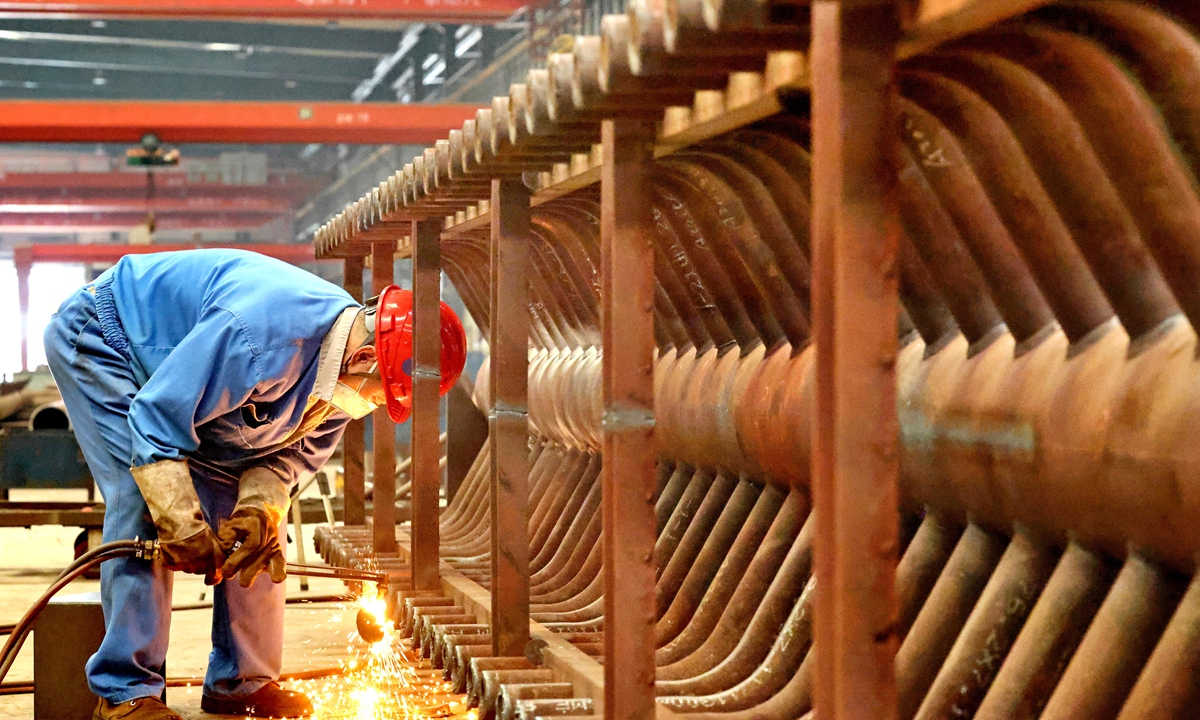
China is not only a major manufacturing power but also a major consuming power. Domestic demand has long been the main engine of the Chinese economy.
To see through the logical fallacy of the "overcapacity" narrative, one must first be clear about where the Chinese economy actually sits in the global landscape.
In the course of economic globalization, China has actively integrated itself into the international division of industrial labor and become the "world's factory" in the truest sense. Chinese manufacturing has enriched the global supply of goods, lowered living costs for consumers in countries around the world, and played an important part in easing global inflationary pressure. But to define China simply as a "producer" on that basis, and from there to conclude that it suffers from "inadequate domestic demand and overcapacity," is a proposition that does not hold water.
From 2013 to 2024, domestic demand contributed an average of 93 percent to China's economic growth, with consumption and investment accounting for an average of 55 percent and 38 percent respectively. China's total retail sales of consumer goods rose from 23.8 trillion yuan ($3.53 trillion) in 2013 to 50.1 trillion yuan in 2025, doubling in size.
Measured at the World Bank's purchasing power parity rates, China's total retail sales of consumer goods in 2025 were 1.7 times those of the US, making the country the world's largest market for consumer goods in all but name. China today ranks first globally in the physical volume of goods consumed, and its per capita annual consumption of some industrial products already approaches the levels seen in developed economies.
China keeps expanding its domestic demand and is working toward a higher-level balance between supply and demand.
Growth in China's total retail sales of consumer goods has slowed somewhat in recent years, and some have taken this as proof of weak domestic demand. That reading is neither objective nor complete.
A strong domestic market provides strategic support for Chinese modernization. The outline of China's 15th Five-Year Plan (2026-30) period devotes a dedicated part to building such a market, stressing the need to adhere to the strategic focus of expanding domestic demand, to expand effective investment, to further implement special actions to boost consumption, to promote the expansion and upgrading of commodity consumption, to unleashing the potential of service consumption, to strengthening the foundation of residents' consumption and to continuously improve the consumption environment - using new demand to guide new supply, and using new supply to create new demand, so as to promote a virtuous cycle between consumption and investment, and between supply and demand, achieve a higher level of dynamic balance between supply and demand.
The slowdown in retail sales growth is consistent with China's shift from high-speed growth to high-quality development, and it also reflects the upgrading of the country's consumption structure. China's consumer market is moving faster from one dominated by goods toward one in which goods and services carry equal weight. Spending on services is growing rapidly and is expected to account for more than half of the total by 2030.
China's super-sized market is not only the bedrock of its own development but also a broad platform on which countries around the world can share in the dividends of that growth.
China has ranked as the world's second-largest importer for 17 consecutive years and is a major export destination for nearly 80 countries and regions. It has granted zero-tariff treatment to 63 countries and regions, becoming the first major economy in the world to extend full zero-tariff coverage to every African country and every least developed country that has diplomatic relations with it. It is also the only country to host an international import expo, having staged eight editions of the China International Import Expo with cumulative intended deals worth more than $580 billion. Over the 14th Five-Year Plan period (2021-25) period, China's cumulative imports topped 90 trillion yuan. These facts and figures show clearly that China is not just the "world's factory" but, still more, the "world's market."
Looking ahead, China's middle-income group is set to exceed 800 million people within little more than a decade, and per capita GDP is expected to reach the level of a moderately developed country. With vast room for consumption and ample potential and vitality, domestic demand will remain the main engine of China's economic development and will keep injecting strong momentum into world economic growth.
This was compiled and translated by the Global Times English edition based on an article published in the "Chisu Jinsheng" economic commentary column of the People's Daily on August 6, 2026.
。
Current article:http://82ix57.dinggaxilianmaiyuejienianguai.shop/5cwq1/20260826/6482060.html
Published on:21:30:25